Residential spider web abatement serves as an immediate protective boundary for structural perimeters, removing the biological material that shelters active populations. Riverside County conditions, marked by arid…
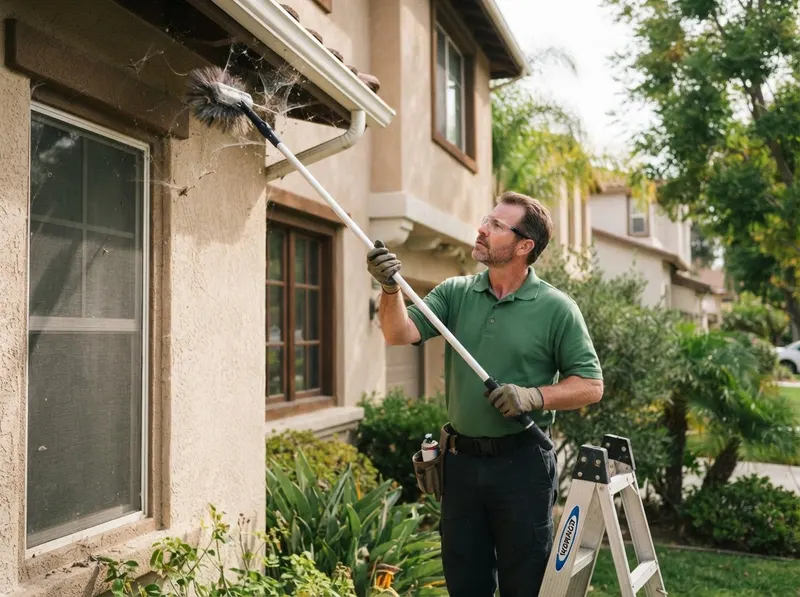
Residential spider web abatement serves as an immediate protective boundary for structural perimeters, removing the biological material that shelters active populations. Riverside County conditions, marked by arid winds from the Box Springs Mountains, irrigation zones in Orangecrest and Canyon Crest, and high night-flying insect traffic around exterior fixtures, create rapid web accumulation. While basic sweeping with a broom only scatters visible silk and leaves microscopic egg clusters viable in exterior cracks, a comprehensive abatement pairs telescoping pole physical removal with contact pyrethroid or botanically derived micro-barrier applications. This stops re-anchoring along stucco lines, window lintels, and decorative wood trims without relying on indoor airborne sprays, preserving indoor domestic air purity.
Selecting standalone abatement fits single-family properties showing dense eave clusters, particularly multi-story structures in Victoria Heights and Hawarden Hills where elevated rooflines prevent safe manual DIY management. The trade-off between physical sweeps alone and chemical perimeter exclusion lies in longevity: physical removal immediately clears aesthetic clutter and reduces food capture, yet without an applied water-resistant barrier along foundation weep screeds and soffit vents, ballooning juvenile spiders re-infest exterior surfaces within 14 to 21 days during peak summer cycles. Property owners seeking targeted seasonal protection get clean architectural sightlines and reduced indoor entry points without signing recurring annual agreements.
Treatments follow a three-step perimeter defense protocol. First, technicians inspect outdoor areas, including covered patios, block perimeter walls, and utility meters near La Sierra and Arlington residences. Second, a 20-foot to 30-foot telescoping brush dressed with specialized web-binding bristles clears intact webbing, dead insect carcasses, and silken egg chambers from second-story eaves down to ground-level foundation vents. Third, a low-drift, non-staining surface barrier is applied to structural entry thresholds, eave junctions, and perimeter lighting fixtures to disrupt pheromone trails and deter secondary crawling insect migration. All work is documented on-site, providing homeowners exact physical assessments before any treatment begins.
Every job gets a firm, written price after a free on-site visit.
Tell us about your residential spider web abatement job in Riverside and we'll send a clear, written quote, usually the same day.
 HomeGuardia Pest Control